
Tree Training / Bending — When, How and Why?
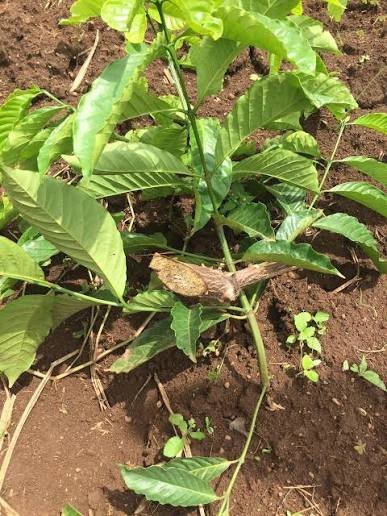
Why Train a Coffee Tree?
Left alone, a Robusta coffee tree grows tall and single-stemmed, putting most of its energy into height rather than the lateral branches that actually carry cherries. Training — bending the main stem while it is still young and flexible — encourages multiple upright suckers (orthotropic shoots) to develop from the base, each capable of bearing its own crop. A well-trained tree carries more bearing wood, stays lower and easier to harvest, and has a longer productive life than one left to grow naturally.
When to Bend
Bending is done while the main stem is still young and pliable — typically once the tree has grown to about knee height, well before it becomes woody. Bending a stem that has already hardened risks snapping it rather than training it. Because coffee planted at the same time doesn't all reach bending stage on the same day, this is a task done in passes across the block rather than all at once.
How It's Done
The main stem is gently bent down and pegged or tied close to the ground, without breaking it, so it lies at a low angle rather than upright. This redirects the plant's hormonal signals: instead of one stem racing upward, several new vertical suckers emerge from the base and lower nodes. Once 3–5 strong, well-spaced suckers have established themselves, they are left to grow on as the tree's new permanent stems, and the original bent stem is eventually removed.
Which way to bend: where possible, bend the stem toward the setting sun (west). This orients the new suckers to come up on the side that gets the fuller afternoon light, giving the tree's new bearing wood a stronger, more even start than a stem bent at random.
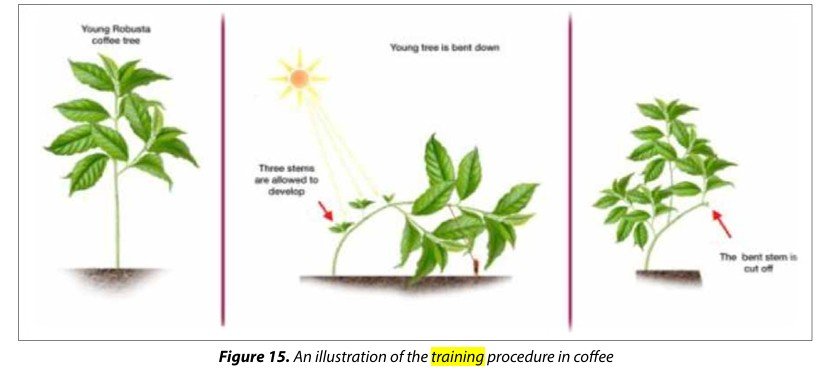
The Exact Steps
This is the procedure as set out in the Robusta Coffee Handbook, and what we follow on our own farm:
- Timing: training/bending is done 5–6 months after planting, or once the coffee tree reaches about 60cm (2ft) in height — well before the stem hardens and becomes woody.
- Direction: bend the original seedling in an East–West direction, pegged down at about a 45° angle, to allow suckers to develop along the tree line. All coffee plants on the farm are bent the same way — towards the west, along the row — so the block trains as one consistent, orderly system rather than a mix of directions.
- Why this works: bending breaks dormancy in the multiple buds at the base of the stem, triggering a flush of new suckers.
- Selecting suckers: choose two suckers if you intend to keep the original bent stem as one of the three eventual stems, or three suckers if you intend to cut the bent stem away later. Pick suckers positioned as low as possible along the base of the trained tree, well spaced from each other, and groom/maintain them as they develop into the tree's future bearing stems. If the original bent stem is still vigorous, it can be kept as one of the three; if it's weak, select three vigorous new suckers instead and remove the weak mother stem.
- Releasing the peg: once the selected suckers reach about 30cm tall, remove the peg — the end of the main bent stem will turn upward again on its own.
An alternative for very young coffee: newly planted trees at 4–6 months can instead be "capped" — the growing tip removed at about 15–30cm (6–16 inches) above ground — which also encourages multiple stems to develop, selected the same way as above.
What Good Training Achieves
- More bearing wood. Multiple stems mean more primary branches, and more primary branches mean more cherries.
- Lower, more manageable trees. Easier and safer harvesting, spraying and pruning.
- A longer productive life. As older stems decline after years of bearing, they can be selectively removed and replaced by newer suckers from the same root system — extending the tree's productive years well beyond what a single, unmanaged stem would achieve.
Training Fits Into a Wider Routine
Tree training doesn't happen in isolation — it's one part of the routine formation pruning, weeding, mulching and pest and disease scouting that a coffee garden needs in its first three years, before it settles into a stable mature bearing structure.
New to coffee farming? Our farmer training sessions cover tree training and bending hands-on, at our Mubende model farm. See our Farm services.